Advanced GPA Calculator – Calculate Your Grade Point Average Instantly
Use our free GPA Calculator to track your academic performance. Perfect for high school and college students planning their educational future.
Semester GPA Calculator
Enter your courses below to calculate GPA
What is GPA? Understanding Grade Point Average
Learn why your GPA matters and how it shapes your academic journey
Defining Grade Point Average
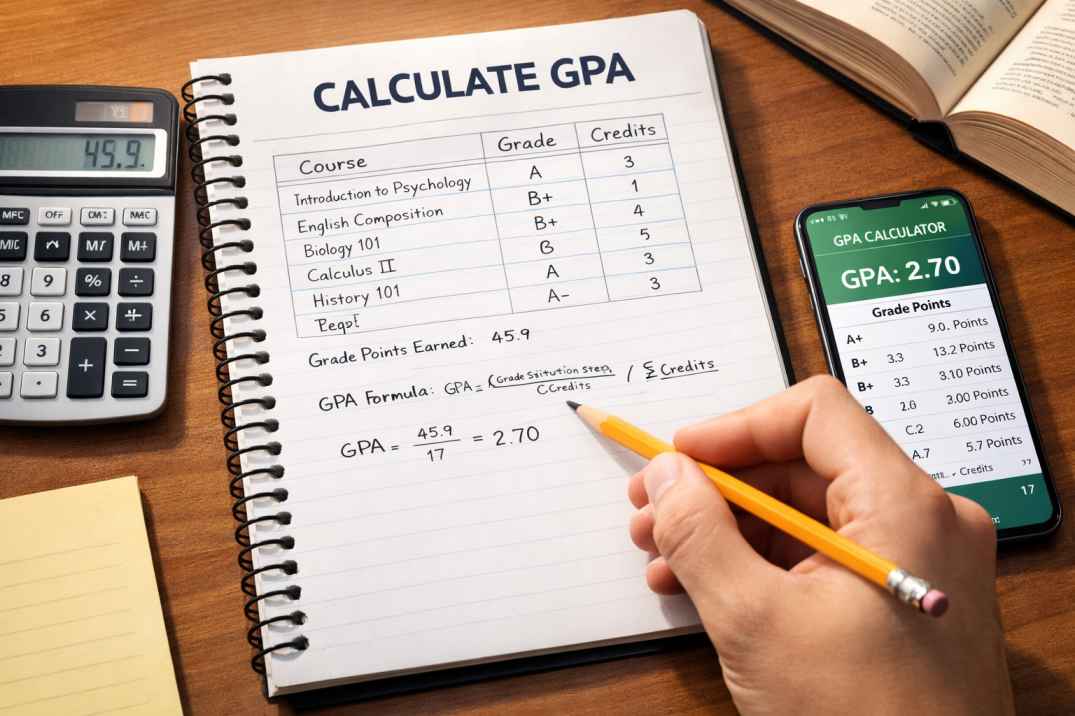
GPA (Grade Point Average) is a standard way of measuring academic achievement in the U.S. educational system. It converts letter grades into a numerical scale, typically ranging from 0.0 to 4.0, allowing schools and employers to quickly assess student performance across different courses and institutions.
Why GPA is Crucial for Students
Your GPA serves as a key indicator of academic success and opens doors to numerous opportunities. A strong GPA demonstrates consistency, work ethic, and mastery of subject matter to scholarship committees, college admissions officers, and future employers.
The Impact of GPA on Your Future
Whether you're applying for undergraduate programs, graduate school, or your first professional position, your grade point average often serves as the first screening criterion. Maintaining a competitive GPA can significantly increase your chances of securing financial aid, internships, and career opportunities in competitive fields.
How our GPA Calculator Tool Works
Follow these simple steps to get your grade point average in seconds
Enter Course Names
Input the name of each course you want to include in your GPA calculation. This helps you organize and track specific classes for accurate semester planning.
Add Credit Hours
Enter the number of credit hours for each course. Typically, standard courses are 3 credits, while labs or intensive courses may carry 4-5 credits.
Select Your Grades
Choose your letter grade from the dropdown menu. Our calculator automatically converts A, B, C, D, and F grades into standard 4.0 scale grade points.
Calculate GPA Instantly
Click the calculate button to see your GPA result immediately. Add or remove courses as needed to experiment with different grade scenarios.
Understanding the GPA Formula
Master the mathematics behind the calculations of GPA Calculator
To calculate your GPA, multiply each course's grade points by its credit hours, sum these values for all courses, then divide by the total number of credit hours attempted.
Standard 4.0 Grade Point Scale
| Grade | Percentage | Points | Level |
|---|---|---|---|
| A | 93-100% | 4.0 | Excellent |
| A- | 90-92% | 3.7 | Excellent |
| B+ | 87-89% | 3.3 | Good |
| B | 83-86% | 3.0 | Good |
| B- | 80-82% | 2.7 | Good |
| C+ | 77-79% | 2.3 | Average |
| C | 73-76% | 2.0 | Average |
| C- | 70-72% | 1.7 | Average |
| D+ | 67-69% | 1.3 | Poor |
| D | 65-66% | 1.0 | Poor |
| F | Below 65% | 0.0 | Failing |
GPA Calculator Chart – Visual Grade Points Scale
Visual representation of the 4.0 grade point scale used in academic calculations
Alt Text: GPA Calculator chart showing grade points scale with letter grades A through F mapped to their respective 4.0 scale values
Benefits of Using Our GPA Calculator
Discover why students rely on our grade point average calculator for academic success
Strategic Academic Planning
Calculate GPA scenarios to set realistic academic goals. Determine exactly what grades you need in remaining courses to reach your target GPA for the semester or overall program.
- Project future semester outcomes
- Identify grade improvement opportunities
- Balance course load effectively
Scholarship Eligibility
Most merit-based scholarships require minimum GPA thresholds. Our calculator helps you monitor your eligibility and maintain the academic standing required for financial aid.
- Track scholarship requirements
- Maintain financial aid eligibility
- Qualify for honor societies
Performance Tracking
Monitor your academic progress over time with accurate GPA calculations. Identify trends in your performance and make data-driven decisions to improve your educational outcomes.
- Semester-over-semester comparison
- Course-specific performance analysis
- Early intervention identification
Real-World GPA Calculation Example
See exactly how to calculate GPA with a detailed semester example
Sample Semester GPA Calculation
Sarah is calculating her GPA for the Fall semester with the following courses:
| Course | Credits | Grade | Points | Quality Points |
|---|---|---|---|---|
| English Composition | 3 | A (4.0) | 4.0 | 12.0 |
| Calculus I | 4 | B+ (3.3) | 3.3 | 13.2 |
| Psychology | 3 | A- (3.7) | 3.7 | 11.1 |
| Biology Lab | 1 | B (3.0) | 3.0 | 3.0 |
| World History | 3 | A (4.0) | 4.0 | 12.0 |
Step-by-Step Calculation Process
- Multiply credits by grade points: English 3×4.0=12.0, Calculus 4×3.3=13.2, Psychology 3×3.7=11.1, Biology 1×3.0=3.0, History 3×4.0=12.0
- Sum all quality points: 12.0 + 13.2 + 11.1 + 3.0 + 12.0 = 51.3 total quality points
- Sum all credit hours: 3 + 4 + 3 + 1 + 3 = 14 total credits
- Apply GPA formula: 51.3 ÷ 14 = 3.66 GPA
Sarah's Semester GPA
On a 4.0 scale – Dean's List eligible!
Cumulative GPA Example
John has completed 3 semesters and wants to calculate his overall GPA:
| Semester | Credits | GPA | Quality Points |
|---|---|---|---|
| Fall 2023 | 15 | 3.4 | 51.0 |
| Spring 2024 | 18 | 3.6 | 64.8 |
| Fall 2024 | 15 | 3.8 | 57.0 |
Cumulative Calculation
- Total Quality Points: 51.0 + 64.8 + 57.0 = 172.8
- Total Credits: 15 + 18 + 15 = 48
- Cumulative GPA: 172.8 ÷ 48 = 3.60
John's Cumulative GPA
Understanding Different Types of GPA
Learn the distinctions between semester, cumulative, and weighted GPA calculations
Semester GPA
Your Semester GPA represents your academic performance for a single academic term only. It includes all courses taken during that specific semester and provides a snapshot of your recent academic achievement.
- Resets each academic term
- Used for academic probation decisions
- Helps track short-term progress
Cumulative GPA
Cumulative GPA (CGPA) represents your entire academic history combined. It includes every course you've taken throughout your academic career and is the primary metric used for graduation requirements and honors designations.
- Includes all semesters combined
- Used for graduation requirements
- Shown on official transcripts
Weighted GPA
Weighted GPA accounts for course difficulty by assigning higher point values to honors, AP, IB, or advanced courses. Instead of the standard 4.0 scale, these courses may contribute 4.5 or 5.0 points, rewarding academic rigor.
- Recognizes course difficulty
- Scale often extends to 5.0
- Used in competitive admissions
Essential Academic References
Authoritative resources for understanding grading systems, academic standards, and educational benchmarks. These curated links connect you to official institutional guidelines.
NCES Grading Systems
Official U.S. Department of Education data on institutional grading practices and GPA calculation methodologies across American universities.
Carnegie Classification
The leading framework for recognizing and describing institutional diversity in U.S. higher education, affecting GPA standards by institution type.
AACRAO Transfer GPA Guide
Professional standards for calculating transfer GPAs, including complex scenarios like repeated courses and credit conversions.
International Grade Conversion
World Education Services official guide for converting international grades to the U.S. 4.0 GPA scale for admissions and credential evaluation.
Harvard Grading System
Faculty of Arts and Sciences official grading policies, including the letter grade to GPA conversion table used by Ivy League standards.
LSAC GPA Calculation Rules
Official LSAC policies for calculating cumulative GPA for law school applications, including handling of withdrawals, incompletes, and retakes.
Verified Academic Sources
Links open in secure new tabs
Frequently Asked Questions About GPA
Get answers to common questions about calculating and improving your grade point average
A good GPA typically falls between 3.0 and 4.0 on a 4.0 scale. Generally, a 3.0 GPA represents a "B" average and is considered satisfactory, while a 3.5 or higher is regarded as very good.
For competitive graduate programs and top employers, a 3.5-3.7+ GPA is often expected. However, "good" is relative to your specific goals—community colleges may accept 2.0 GPAs, while Ivy League schools often require 3.8+ for admission.
To improve your GPA effectively:
- Prioritize high-credit courses since they impact your GPA more significantly
- Retake courses where you earned poor grades—many schools allow grade replacement
- Seek help early through tutoring, office hours, or study groups
- Balance your course load by mixing challenging classes with subjects where you excel
- Use our GPA calculator to set specific grade targets for remaining assignments
Unweighted GPA uses a standard 4.0 scale regardless of course difficulty—an A in regular English and an A in AP English both equal 4.0.
Weighted GPA assigns extra points (typically 0.5 or 1.0) for honors, AP, IB, or advanced courses, allowing students to earn above 4.0. Weighted GPAs recognize academic rigor and can exceed 4.0 (often capped at 5.0).
Pass/fail courses typically do not impact your GPA numerically. If you pass, you receive credit hours but no grade points; if you fail, you receive neither.
This makes pass/fail options valuable for exploring challenging subjects without risking your GPA. However, some professional schools (medical, law) may convert pass grades to specific GPA values or require traditional grades for prerequisites.
Most institutions do not include transfer credits in your GPA calculation. When you transfer schools, your new institution typically applies a "clean slate" policy where only courses taken at that specific school count toward your institutional GPA.
However, your original GPA remains on your transcript from the previous institution, and some graduate programs may calculate a combined GPA across all attended schools.
Yes! You can calculate GPA for any specific time period using our calculator. Simply enter only the courses from the desired timeframe—whether that's a single semester, academic year, or specific program phase.
This is useful for tracking improvement trends, meeting scholarship renewal requirements, or determining eligibility for academic honors. Our tool allows you to add and remove courses freely to experiment with different scenarios.